You have no items in your shopping cart.
Course Details
Course Details
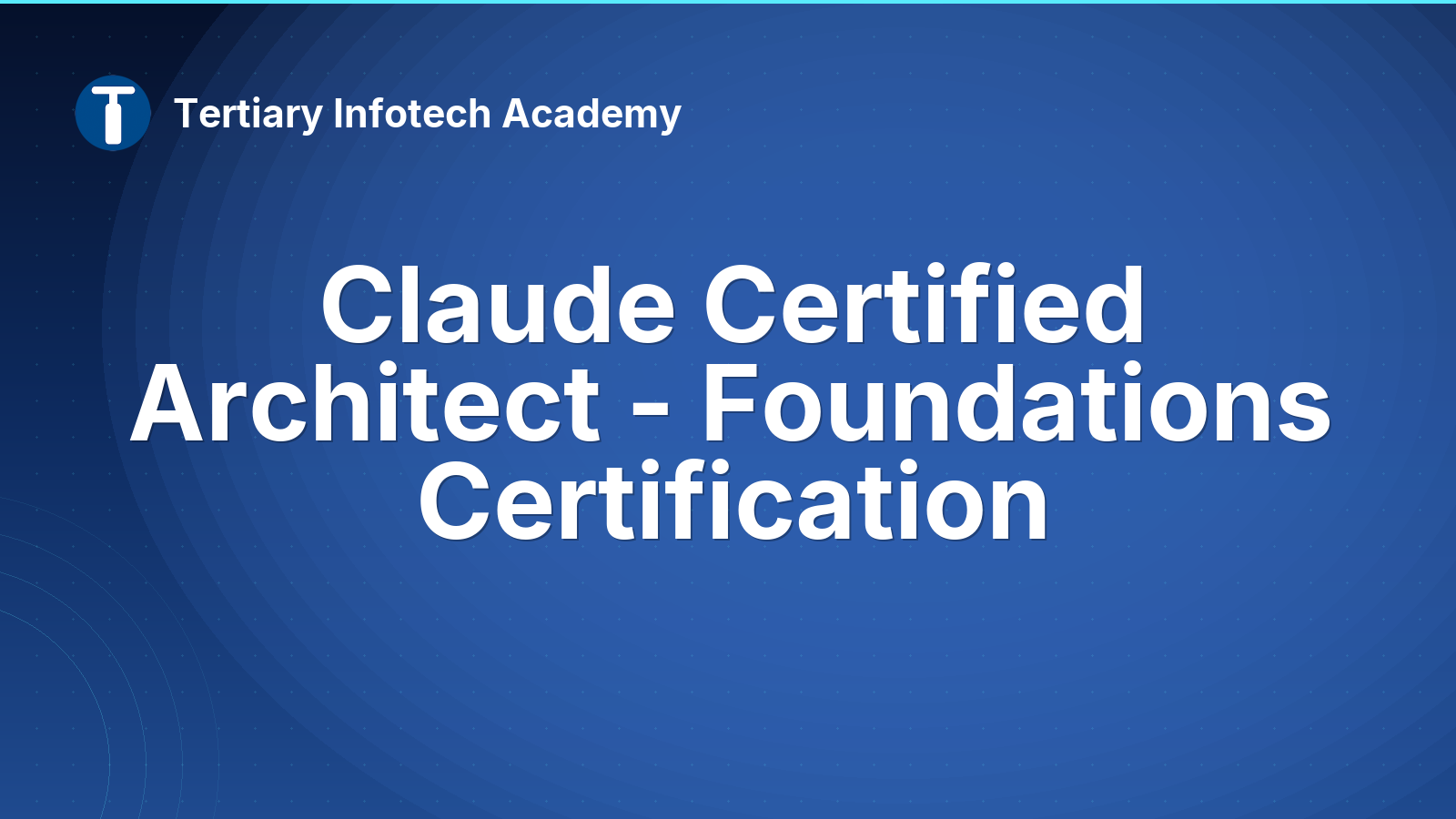
What You'll Learn
Domain 1 Agents and Workflows (14.7%)
- Apply agent and workflow architecture patterns and decide when to use a workflow versus an agent
- Construct Claude agents with the Claude Agent SDK, custom agent loops and harnesses, and hooks for deterministic actions
- Choose managed deployment models (self-hosted vs Anthropic-hosted) and design manager/subagent hierarchies
- Apply agent design patterns (tool-use loops, sub-agents, memory, context-window management) and frameworks such as Strands, LangGraph and PydanticAI
Domain 2 Applications and Integration (33.1%)
- Translate business requirements into functional and infrastructure requirements and manage the systems life cycle
- Apply Claude API mechanics (messages, tools, streaming, vision, thinking, caching, batch API, realtime vs batch tradeoffs)
- Apply software engineering foundations (REST APIs, JSON, async programming, version control, code review, refactoring)
- Design Claude applications across interfaces (Claude Code, Desktop, claude.ai, API, SDKs) with sound schema design and session hygiene
- Manage configuration with CLAUDE.md files, settings.json, model version pinning, prompt versioning and plugin dependencies
Domain 3 Claude Code (3.1%)
- Operate Claude Code core components (Rules, Skills, Commands, Agents, Agent Memory)
- Use session management, built-in and custom slash commands, headless, streaming and auto modes
- Apply the CLAUDE.md hierarchy, repository initialization and settings.json configuration
Domain 4 Eval, Testing and Debugging (2.6%)
- Debug and handle errors in Claude applications (error type identification, recovery strategy selection)
- Use trace analysis to identify failure modes
- Isolate problem origin between the integration layer and model output
Domain 5 Model Selection and Optimization (16.8%)
- Apply LLM fundamentals (tokens, context windows, sampling, non-determinism, next-token generation) and thinking modes (fast, extended, adaptive, effort levels)
- Apply technical fundamentals of AI application development (SDKs wrapping REST APIs, websockets)
- Select models by capability and tradeoffs (Opus vs Sonnet vs Haiku; quality, latency, cost; behavior changes across releases)
- Manage cost and tokens (usage tracking, cost modeling, prompt caching, cache check-pointing)
Domain 6 Prompt and Context Engineering (11.0%)
- Engineer context (context-window management, preventing context drift and bloat via tool-output pruning and compaction, context isolation through subagents)
- Engineer prompts (instruction clarity, few-shot examples, system vs user placement, output constraints, iterative refinement, input sanitization)
- Handle output with structured-output patterns, response validation, defensive parsing and skepticism toward confident output
Domain 7 Security and Safety (8.1%)
- Apply AI application security (prompt-injection mitigation, jailbreak defense, untrusted-input handling, data-leakage and PII prevention, authentication, authorization, confidentiality and integrity)
- Apply guardrails and secure-by-design deployment (content policy, guardrail layering, least privilege)
- Leverage Claude hooks to prevent destructive actions
- Manage identity, secrets and API keys across development and production environments
Domain 8 Tools and MCPs (10.6%)
- Implement tools and function calling (tool description writing, error handling, agentic harness dispatch, client-side vs server-side tools, approval patterns)
- Weigh tradeoffs across built-in tools, custom tools, Skills and MCPs
- Develop MCP servers (server authoring, deployment, MCP resources, tools and prompts)
- Apply MCP communication patterns (stdio, sockets, client vs server)
Course Info
Promotion Code
Your will get 10% discount voucher for 2nd course onwards if you write us a Google review.
Minimum Entry Requirement
Knowledge and Skills
- Able to operate using computer functions
- Minimum 3 GCE ‘O’ Levels Passes including English or WPL Level 5 (Average of Reading, Listening, Speaking & Writing Scores)
Attitude
- Positive Learning Attitude
- Enthusiastic Learner
Experience
- Minimum of 1 year of working experience.
Target Age Group: 18-65 years old
Minimum Software/Hardware Requirement
Software:
TBD
Hardware: Window or Mac Laptops
Job Roles
Job Roles
- Unity Developer
- C# Game Programmer
- Game Designer
- Mobile Game Developer
- 2D/3D Game Developer
- Unity UI/UX Designer
- Game Animation Specialist
- Game Scripting Specialist
- Unity Technical Artist
- Virtual Reality (VR) Developer
- Augmented Reality (AR) Developer
- Game Prototyping Specialist
- Game Quality Assurance (QA) Tester
- Game Development Consultant
- Game Content Creator
- Indie Game Developer
- Game Effects (FX) Designer
- Unity Instructor/Trainer
- Game Deployment Specialist
- Unity Version Control Specialist
Trainers
Trainers
Saeid is co-founder of Skymics Sdn Bhd. He has 8 years of experience in the field of IoT (Internet of Things) and Information Technology. He is a certified IBM IoT Practitioner and instructor, and a Certified Citizen Data Scientist Train-The-Trainer. He has been co-inventor of 3 inventions during the last 4 years.
Review
Customer Reviews (8)
- Very satisfied Review by Course Participant/Trainee
-
The course materials were detailed and easy to reference afterwards. Great value for money. (Posted on 17/02/2025)1. Do you find the course meet your expectation? 2. Do you find the trainer knowledgeable in this subject? 3. How do you find the training environment - Very satisfied Review by Course Participant/Trainee
-
Very informative and interactive. The small class size meant we got a lot of personal attention. (Posted on 13/09/2024)1. Do you find the course meet your expectation? 2. Do you find the trainer knowledgeable in this subject? 3. How do you find the training environment - Exceeded my expectations Review by Course Participant/Trainee
-
Solid content and a supportive trainer. I would definitely sign up for more courses here. (Posted on 13/02/2024)1. Do you find the course meet your expectation? 2. Do you find the trainer knowledgeable in this subject? 3. How do you find the training environment
Write Your Own Review
- Recommended Courses